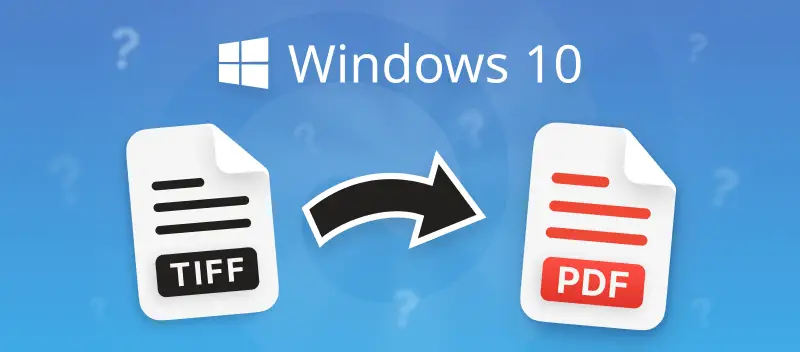

Need to turn your TIFF files to PDFs on Windows 10? Don’t worry—it’s honestly a breeze. You’ve got a couple of good options: you can use an online converter (super quick, no downloads needed), or go with a classic desktop app if you’d rather keep things on your computer.
Both ways are solid, so just pick whatever feels easiest for you. If you want fast and simple, web-based the way to go. If you like a bit more control, offline apps have your back. I’ll walk you through both, step by step, so you’ll have those TIFFs switched over to PDFs in no time. Let’s get started!
What is TIFF?
TIFF—that’s Tagged Image File Format if you really want to show off—is kind of the superstar for crisp, detailed footage. Photographers, designers, anyone who’s picky about quality? They’re all about TIFFs. If you want your picture to look like it rolled out of a spa, this is the file you want.
Key features of the format:
- First up, lossless compression. That’s just a fancy way of saying your visual stays looking perfect—no weird fuzziness.
- TIFFs can hold layers and even a bunch of graphics inside one file. Like an album in an archive, basically.
- Heads up, though—these are kind of chunky. They take up more space than JPEGs, but that’s the trade-off for all that gorgeous detail.
- They play well with all sorts of color setups and bit depths, so whether you’re snapping pics or making magazine covers, TIFF’s got your back.
- There’s room for all kinds of metadata too, like camera settings and who took the shot. Pretty handy if you’re into that kind of thing.
| Type | Description |
|---|---|
| Uncompressed | Stores data without loss, maintaining the highest quality. |
| Compressed | Reduces size using methods like LZW, PackBits, or JPEG. |
| Multi-page | Combines several images into one file. |
| Indexed | Utilize a palette to represent colors, ideal for pictures with fewer hues. |
| CMYK TIFF | Applies the CMYK model, typically applied for print and color separation in design. |
Method 1. PDF Candy Desktop for Windows
PDF Candy Desktop is honestly pretty great if you mess with PDFs a lot.
You just pop it onto your Windows PC and boom—no Internet needed. It lets you flip files to and from PDF, merge a bunch together, split them up, squeeze down giant docs.
How to convert TIFF to PDF in Windows 10 or 11
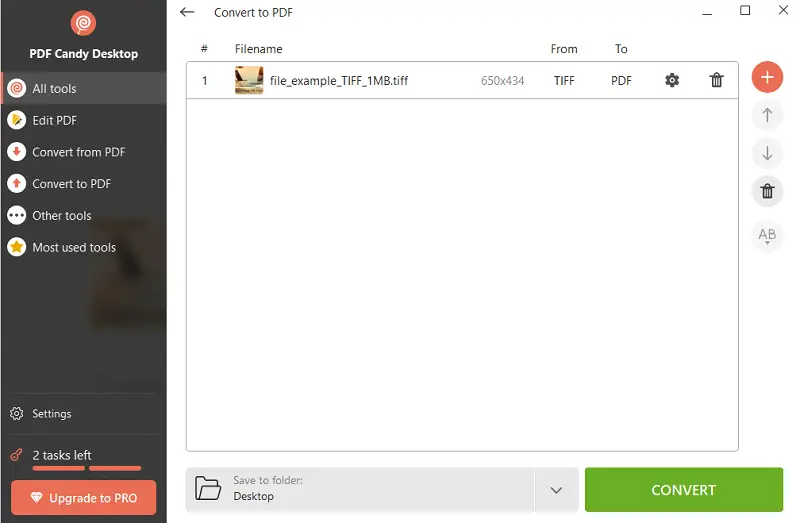
- Download and install the PDF converter for Windows PC. Launch the application.
- Select the "TIFF to PDF" option from the format list.
- Upload your images into the converter.
- Set the location to save the PDF after conversion. Optionally, adjust settings such as page orientation, margins, and quality by pressing the gear icon.
- Hit "Convert" to start the processing.
- Once the conversion is complete, the "Open Folder" message will appear. Press it to access the resulting document.
Pros:
- User-Friendly Interface. Seriously, if you can click a mouse, you’re good to go. The layout’s a breeze—no tech headaches, just smooth sailing.
- Security. Everything happens right on your computer, so your files aren’t flying off into cyberspace. Only you are peeking at your stuff.
- Batch Processing. Got a stack of TIFF? Throw them all in and let the program handle it. More time for coffee (or cat videos, no judgment).
- Tailored Results. Want your PDF a certain way? Tweak the settings and make it happen. You’re in control here.
- Free Access. All the basics are free, so you (and your wallet) can relax. Whether you’re a student or just don’t want to spend, it’s all good.
- Versatility. Need to merge, split, or edit PDFs too? Yup, it’s got you covered—like a useful multitool but digital (and actually helpful).
Ideal for:
- Architects: Work with extensive sets of TIFF blueprints; batch conversion streamlines packaging them into accessible PDFs.
- Archivists: Handle digitized collections; offline processing safeguards sensitive heritage material.
Method 2. PDF Candy
PDF Candy is honestly such a lifesaver. It’s all online—nothing to download, nothing complicated. You just go to the website and you get a whole toolbox for PDFs right at your fingertips.
Want to change a TIFF to a PDF? It takes like a minute. And it’s perfect for those moments when you’re in a rush or don’t want to mess around with extra software.
How to convert a TIFF image to PDF online
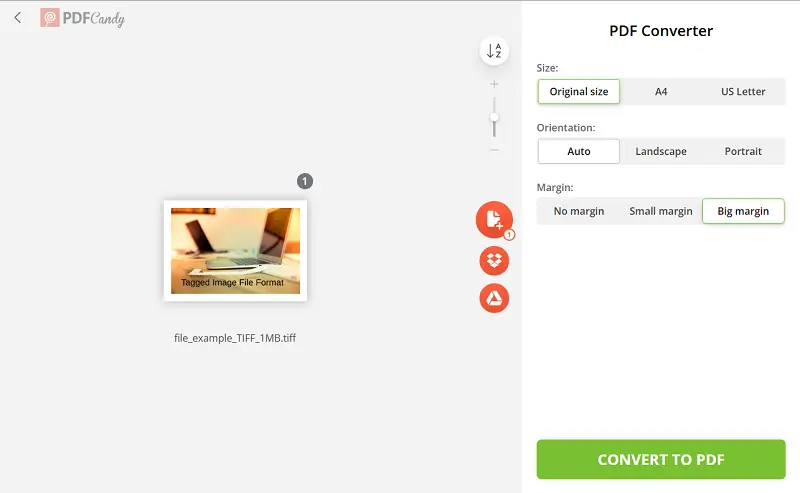
- Open the online TIFF to PDF converter in your web browser.
- Click the "Add file(s)" button to upload your TIFF image(s). Alternatively, drag and drop the pictures directly into the designated area.
- Once uploaded, adjust the settings such as orientation, margins, or page size.
- Press "Convert to PDF" to initiate the operation.
- Save the PDF file(s) to your computer by hitting the "Download file" button.
Pros:
- No PDF Software Installation. Forget about downloading yet another random app—just pop open your browser and you’re good to go.
- Intuitive Interface. The platform offers an easy-to-use interface, allowing individuals to quickly navigate through the conversion process.
- Variety of tools. It does way more than TIFF to PDF. Need to swap a JPG for a PDF? Or turn a PDF into a Word doc? It’s all there.
Ideal for:
- Event Planners: Transform vendor agreements or image-based proposals into shareable PDFs quickly, even on borrowed computers.
- Marketing Specialists: Switch design previews or campaign visuals into a format that’s simple to present to clients.
TIFF vs other formats
| Format | Quality | Compression | Color Depth | Transparency | File Size | Use Case |
|---|---|---|---|---|---|---|
| TIFF | High-quality. | Lossless (LZW, ZIP) or no compression. | 1-bit to 32-bit. | Supports alpha channels. | Can be large. | Professional photography, scanning, archiving. |
| JPEG | Compressed. | Adjustable lossy compression. | Typically 24-bit (8 bits per channel RGB). | No transparency. | Generally smaller. | Web, digital shots, where file size matters. |
| PNG | Lossless. | Lossless (DEFLATE). | 24-bit color, 8-bit transparency. | Full alpha channel. | Moderate. | Images requiring transparency, web graphics. |
| GIF | Limited color depth. | Lossless (LZW). | 8-bit (256 colors). | 1-bit transparency. | Small. | Simple graphics, animations with limited colors. |
| RAW | High-quality. | Varies; often lossless or minimally lossy. | 12-bit or 14-bit per channel. | No transparency. | Large. | High-quality capture and post-processing in photography. |
| WebP | Efficient | Lossy or lossless. | 24-bit color, 8-bit alpha channel. | Full alpha channel. | Small. | Web use with efficient compression and high quality. |
| Versatile, can include high-quality visuals and vector graphics. | Varies (JPEG, ZIP, etc.). | Depends on content (text, vector, pics). | Supports transparency in drawings and vectors. | Can vary widely. | Documents combining text, paintings, and graphics where formatting is important. |
FAQ on how to convert TIFF to PDF
Can I turn TIFF into PDF using built-in Windows 10 tools?
Not really, sadly. Windows 10 doesn’t have a magic button for TIFF to PDF conversion. You’ll need to find a third-party app or follow online to use something like PDF Candy. It’s not a big deal, but I wish it was easier!
Can I edit the PDF I get after conversion?
Oh, absolutely! Tons of PDF editors out there for Windows 10, and you don’t have to spend a fortune. Just pick one you like, and you’ll be able to tweak and change your PDF however you want.
How do I convert a TIFF to a searchable PDF?
So, for that, you’ll want to look for Optical Character Recognition (OCR). Apps like PDF Candy, Adobe Acrobat Pro, or ABBYY FineReader can turn your TIFF into searchable PDFs. Super handy if you don’t want to scroll forever looking for something.
How do I ensure the quality of the converted PDF?
Honestly, just use trustworthy software and double-check the settings—like image size and resolution—before converting. Good programs usually keep things looking sharp.
What should I do if the TIFF is corrupted and won’t convert?
That’s the worst. If your file’s corrupted, try some repair instruments or see if you’ve got an older version backed up somewhere. Sometimes you get lucky—you never know.
Is it possible to password-protect the converted PDFs?
Yep, totally possible! Most converters and PDF editors let you put a password on your paper, so your info stays private. Just don’t use something obvious. Keep it a little mysterious.
Conclusion
Converting a TIFF to a PDF on Windows 10 or 11? Super plain, honestly. There are tons of ways to do it, so you’ve got options. If you’re feeling lazy, try an online converter—literally drag, drop, and click. Or, if you’re more of a "desktop app" type, there’s plenty of programs that’ll do the trick.
Just follow a couple simple step sand you’ve got a PDF. the format is a way easier to deal with, and everyone’s devices love them. So once you make the switch, sharing and managing your files is a breeze. You’ll wonder why you didn’t do this sooner!